Five acres of Mayan jungle, a temple built for ceremony, and eleven years with the Shipibo-Conibo. Where facilitators host plant medicine retreats in Mexico.
When you are looking for a plant medicine retreat venue in Mexico, the questions that matter go beyond the photos. They are about how the space actually holds ceremony — the acoustics of the temple after midnight, the water source your guests will drink from, the family that will be present when the work gets real. After hosting plant medicine retreats at Casa Arkaana since 2021, I have watched what facilitators actually look for when they choose where to hold ceremony.
It is not a venue in the tourism sense. It is a container. And what most centers offer — a beautiful setting, a nice temple, a functional kitchen — is not enough on its own. What holds a retreat is the sum of the land, the space, the people present, and the standards behind the operation. This article is about what makes Casa Arkaana a container worth considering for your next retreat.
What Facilitators Look For — And What We Offer
After years of conversations with facilitators from the United States, Canada, Europe, and Mexico, the same criteria come up. Not in any specific order:
- A purpose-built ceremonial space that can hold an all-night ceremony with dignity — not a converted yoga shala, not a rented villa
- Full privacy — one group at a time, no other guests wandering through, no schedule clashes with wellness travelers next door
- Water, fire, earth — a cenote-fed pool, temazcal, fire circle, forest — all within walking distance of the temple
- A kitchen that understands dieta — real food, prepared with intention, aligned with the ceremonial rhythm
- A ground team that has done this before — logistical and energetic support, present but not intrusive, ready when something needs to happen quietly and quickly
That is what Casa Arkaana is built around. Not as a list of features but as one container that has been refined over four years of hosting retreats and eleven years of ceremonial practice.
The Temple
The temple is the first thing most facilitators want to see. It should be.
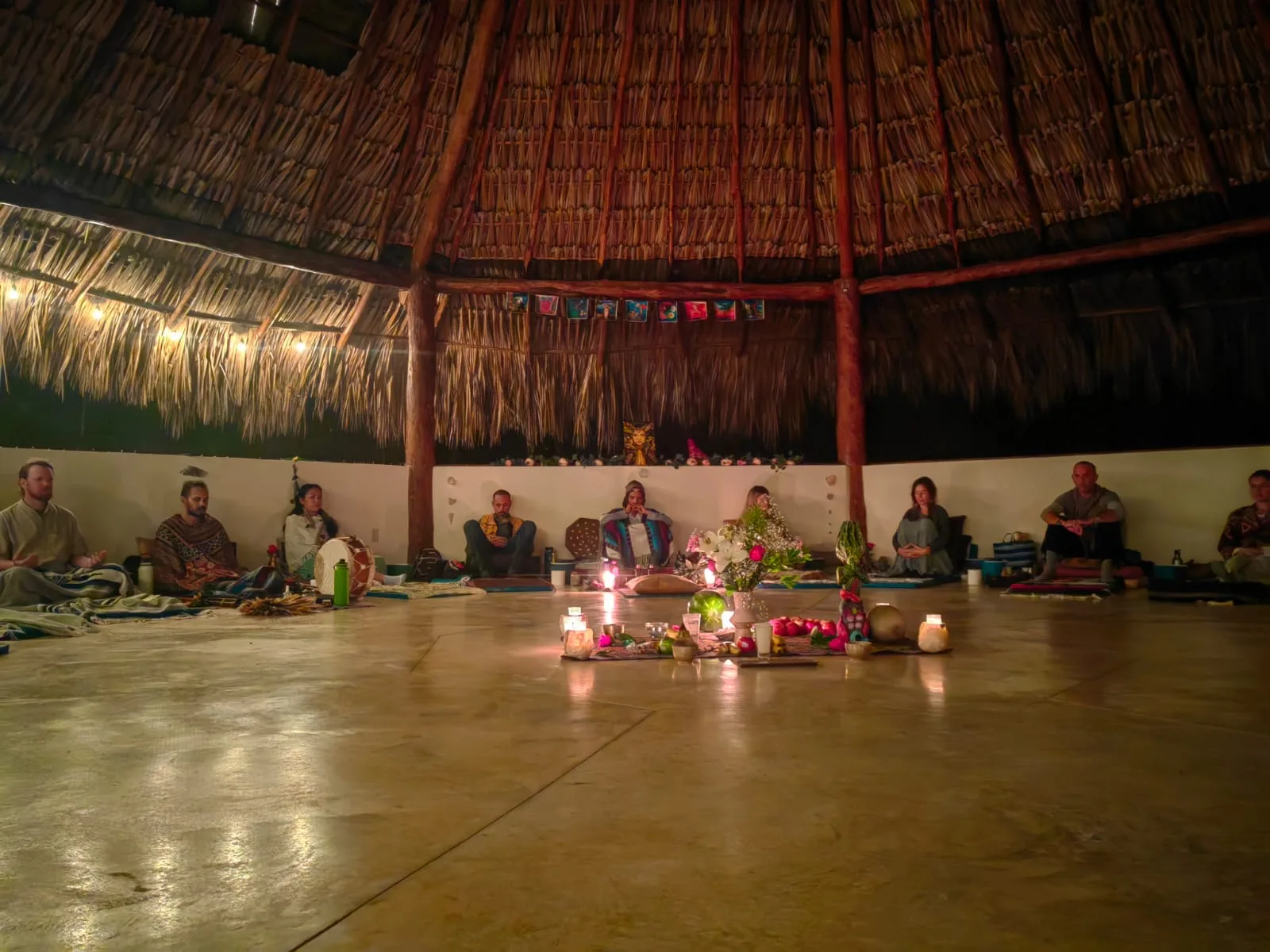
Ours is octagonal, purpose-built for ceremony. The floor is embedded with quartz. The walls carry amethyst and rose quartz. Every stone was placed with intention before the space was ever used. It is open to the jungle canopy but fully enclosed in mosquito netting — no interruptions once the medicine has been served. The acoustics were designed for icaros and prayer, not for general gathering.
There is space for a full circle of 20 to 30 people. Bathrooms are a few meters away from the temple so people can do their thing without disturbing the circle. It has been held ceremonially since it was built — cleaned, prayed over, kept intact.
Facilitators consistently tell us this is the strongest temple they have worked in on this side of the border. That is not a marketing claim. It is what they say after their first ceremony.
The Land — Five Acres of Mayan Jungle
Casa Arkaana sits on five acres of intact Mayan jungle. This land is part of a biological corridor — jaguar still move through at night, spider monkeys pass in the canopy, boas rest in the old trees, toucans call at dawn. The underground river system beneath us has been flowing through limestone for millennia. The cenote water our pool draws from has been sacred to the Maya since long before any of us named this place.
The cenote-fed pool, the temazcal, the fire circle, and the temple are all within seconds of each other. A facilitator can lead a fire ceremony at dusk, an all-night medicine ceremony inside the temple, a temazcal at dawn, and a cold cenote plunge after — without anyone leaving the container.
The land itself is part of the work. Guests consistently describe it as part of the healing, something that begins working the moment they arrive. That is not decorative language. It is what the medicine seems to confirm again and again.
Eleven Years with the Shipibo-Conibo — as Co-Holders, Not Facilitators
Maja and I have been dieting with the Shipibo-Conibo lineage for eleven years. We have been students of Maestro Gilberto Mahua — a Shipibo Elder, the last living curandero of his lineage — since before we were married. We are not facilitators. We are witnesses, participants, students, and co-holders of the space.
This matters when you are choosing where to host. Because the people running the venue understand what is being held. When something arises in a ceremony — and things do arise — we know what to do and what not to do. We know when to be present and when to be invisible. We know how to hold a container from the outside so the facilitator can hold what is happening inside.
That understanding cannot be trained in a hospitality course. It is built through years of sitting on the other side of the cup.
Logistics
The other reason facilitators choose Mexico — and specifically the Riviera Maya — is the accessibility.
- Cancún Airport (CUN): 90 minutes by car. Direct flights from most major cities in North America and Europe — New York, Toronto, London, Berlin, Madrid, Frankfurt. Often surprisingly affordable.
- Tulum International Airport (TQO): 60 minutes by car. New, less busy, growing.
- Discretion: No signage on the road. No public listing under the “ceremony” or “ayahuasca” label. Guests arrive through a driveway that looks like any other property until the gate opens.
- Reliable internet. Medical facilities within reach (Tulum ~25 min, Playa del Carmen ~45 min). Mobile phone signal on the property.
- No overlap. When you book Casa Arkaana, the whole property is yours during your dates. No other guests, no other groups, no shared spaces.
What We Ask From Facilitators
This is where we are more selective than most venues.
We ask about your lineage — who did you train with, for how long, in what tradition. We ask about your screening protocol for participants: preparation documents, health questionnaires, real conversations, contraindication policies. We ask about your integration support — what happens after guests leave your care.
We are not gatekeeping the tradition. We are being honest about what the container requires. A facilitator who does not screen is a facilitator we cannot host. Not because we are demanding perfection, but because we are responsible for what happens on this land. The trust of the guests who come here, the ceremonies that have been held here, the standards we hold ourselves to — these things compound. Every retreat either strengthens the container or weakens it.
If your practice matches how we work, we will know within one conversation. If it does not, we will say so honestly and point you toward centers that may be a better fit. That honesty is part of what we offer.
If You Are Considering Hosting Here
If what you have read resonates and you would like to explore whether Casa Arkaana is the right venue for your next plant medicine retreat, the plant medicine hosting overview has the formal picture — inclusions, pricing structure, and what a collaboration with us looks like.
We have also put together a Host Pack — the full picture of pricing, dates, capacity, and what a retreat here looks like end to end.
If you would rather have a real conversation first, book a 15-minute call. No agenda — just a chance to hear what you are working on and see whether the match is there.
Casa Arkaana is an ecological retreat center that hosts independent facilitators. We do not provide, sell, or administer plant medicines. All ceremonial work is designed and led by the retreat facilitator and their team.
Frequently Asked Questions
Does Casa Arkaana facilitate plant medicine, or do you host outside facilitators?
We host outside facilitators. Casa Arkaana does not provide or administer plant medicines directly. Each retreat is designed and led by the facilitator and their ceremonial team. Our role is to provide the physical and energetic container — the temple, the land, the kitchen, dieta-aligned meals, and Asdru and Maja's presence throughout every retreat as co-holders of the space.
Can I bring my own ceremonialist and medicine?
Yes — that is exactly how we work. You bring the lineage, the ceremonial team, and the medicine. We provide the venue, the logistical support, and the container. We do screen facilitators as carefully as facilitators should screen participants: we ask about your lineage, your training, your protocols, and the medicines you plan to work with. Not everyone is a fit. That is the point.
What lineages have hosted plant medicine retreats at Casa Arkaana?
We have hosted facilitators working within the Shipibo-Conibo tradition, the Wixárika peyote tradition, the Santo Daime tradition, and independent lineage holders working with cacao, kambo, and other plant allies. Ayahuasca and other sacred medicine ceremonies have been held here since 2021. The through-line is lineage, training, and integrity — not any single tradition.
How does the temple support all-night ceremony?
Our temple is octagonal, purpose-built for ceremony, open to the jungle canopy but fully enclosed in mosquito netting. The floor is embedded with quartz. The walls carry amethyst and rose quartz. The acoustics were designed for icaros and prayer, not general gathering. There is space for 20 to 25 people in a full circle. Bathrooms are attached — no walking through the jungle at 3 a.m. It has been held ceremonially since it was built.
What screening do you require from facilitators?
Before we confirm dates, we talk. A video call, not a form. We ask about your lineage and training, your ceremonial protocols, your screening process for participants, your integration support, and your experience holding groups. If we have not worked with you before, we may ask for a reference from someone whose ceremony we know. This is not a formality. It is how the container stays strong.
What is included when I book Casa Arkaana for a plant medicine retreat?
Exclusive use of the entire five-acre property — no overlap with other groups, no shared spaces. Accommodation for up to 20 guests across ensuite rooms, jungle casitas, and glamping tents. The temple, cenote-fed pool, temazcal, and fire circle. Dieta-aligned meals prepared by our kitchen. Airport transfer coordination. Asdru and Maja's presence throughout as co-holders of the container. Full pricing and inclusions are in the Host Pack.
What are the best months for plant medicine retreats at Casa Arkaana?
September through June. High season runs from late September through the end of June — drier, more comfortable, and the period when the jungle holds ceremony best. July and August we use for maintenance, restoration, and rest. Plant medicine facilitators tend to book six to twelve months in advance for the equinoxes, solstices, and new moons that anchor most retreat calendars.
Can I visit before booking?
Yes. We prefer it, actually. For facilitators considering hosting at Casa Arkaana, we offer a site visit — usually a half-day, sometimes overnight. You walk the land with Asdru, see the temple, meet whoever from our team is on site, and get a real feel for whether the container matches what you are holding. This is more useful than any brochure.