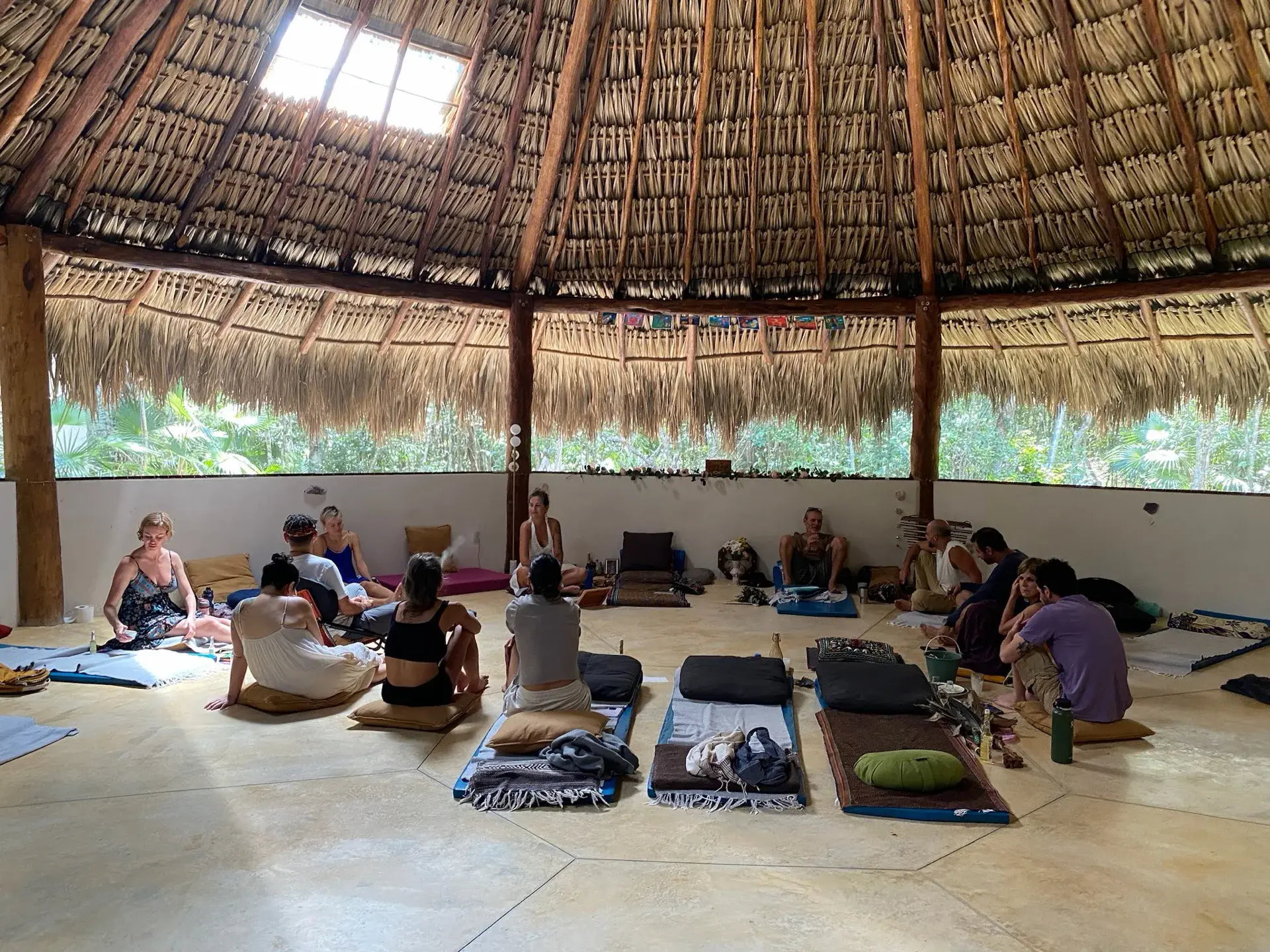
Since 2021, a five-acre jungle sanctuary 20 minutes from Tulum has hosted ayahuasca retreats led by lineage-trained facilitators. Held with care, always.
Ayahuasca retreats in Mexico have grown from a quiet, word-of-mouth path to one of the most sought-after ceremonial experiences in the Americas. Seekers arrive in the Riviera Maya for the same reason indigenous communities have honored this medicine for centuries — healing, clarity, and a reconnection with what matters most. What has shifted is where the work is being held, and who is holding it.
Casa Arkaana is an ecological retreat center in Chemuyil, 20 minutes from Tulum, that has hosted ayahuasca retreats and other plant medicine ceremonies since 2021. The land, the temple, and the entire container are designed to support this kind of deep work — held with reverence, care, and a long relationship with ceremonial tradition.
What Is Ayahuasca?
Ayahuasca is a traditional Amazonian brew that has been used for centuries by indigenous communities — particularly in Peru, Colombia, and Brazil — for healing, spiritual insight, and communication with the natural world. It is prepared from the Banisteriopsis caapi vine and other sacred plants, and is held within a ceremonial context guided by a trained facilitator or curandero.
The experience is typically approached with deep mental and physical preparation — a period of quieting the noise, adjusting the diet, and stepping back from the pace of daily life — followed by clear intention and a period of integration afterward. Those who seek it out often describe it as one of the most significant experiences of their lives — though outcomes vary widely depending on the individual, the facilitator, and the setting.
Today, many people travel to countries like Mexico, Peru, and Costa Rica to participate in ayahuasca retreats in settings that honor the tradition — held by facilitators with genuine lineage, training, and ceremonial experience.
Ayahuasca Retreats in the Mexican Jungle
Mexico’s Riviera Maya offers a landscape that naturally supports this kind of work. Ancient cenotes, dense jungle canopy, a Mayan cosmological heritage, and a climate that keeps you connected to the elements — all of it creates conditions that are very different from a hotel or urban retreat center.
Casa Arkaana sits on five acres of intact Mayan forest. The property is fully solar-powered, spring-fed, and built with bioclimatic design — open to the jungle breeze, cooled by the canopy above. The cenote-fed pool draws from aquifers deep beneath the land. The fire circle, the temazcal, and the old-growth trees are part of the same living ecosystem that supports the ceremonial work.
Guests consistently describe the land itself as part of the healing — something that begins working the moment they arrive, before any session starts.
The Meeting of the Eagle and the Condor
There is a teaching that has traveled across the Americas for generations — carried by runners, by ceremony, by the people who still remember it. It speaks of the Eagle of the North and the Condor of the South. Two paths that were once separated. The path of the mind and the path of the heart. The path of industry and the path of the earth. The prophecy says that one day they would fly together again.
They meet in the middle. They have always met here.
In 1992, the first Peace and Dignity Journey — a ceremonial run connecting the continent — departed simultaneously from Alaska and Tierra del Fuego. The runners met at Teotihuacan, just outside Mexico City. That was not a coincidence. Mesoamerica has always been the crossroads.
What that means for plant medicine is visible if you pay attention. Shipibo healers come north to Mexico. Taitas from the Putumayo travel through. Yawanawá and Huni Kuĩ teachers make their way up the continent. The traditions move — not because Mexico is the destination, but because it is the meeting place. Information passes through here. Lineages encounter each other here. Something is gathered here that is hard to name and easy to feel.
Ayahuasca is not from Mexico. But it has been received here with seriousness, and it is held here by people who understand the responsibility that comes with it. Asdru and Maja have been dieting with their Shipibo Maestro for eleven years. They are not facilitators. They are witnesses, students, and co-holders — people who understand what a container must be before it can hold anyone else.
Our Role at Casa Arkaana
Casa Arkaana is a retreat center that hosts independent facilitators. We do not provide or administer plant medicines directly. Each retreat held here is designed and led by its own facilitator — a ceremonial guide, lineage-holder, or integration specialist who carries their own training, protocols, and ethical commitments.
Our role is to provide the physical and energetic container that makes this work possible:
- A private sanctuary with one group at a time — no overlapping retreats
- An octagonal temple (ceremonial space) built for all-night ceremony — open to the jungle, fully enclosed in mosquito netting, protected from weather
- Dieta-aligned meals prepared from local and farm-grown ingredients
- A cenote-fed pool, fire circle, and temazcal as spaces for integration and preparation
- Logistical and energetic support from Asdru and Maja, who are present throughout every retreat
Asdru and Maja have been dieting with different master plants for 11 years — training, attending ceremonies, learning how to hold space for others, and periodically hosting their Maestro Gilberto Mahua, Shipibo Elder, the last living curandero of his lineage and his family at Casa Arkaana. This relationship shapes how the space is held and the standards they apply when welcoming facilitators.
Preparation and Safety
Preparing for an ayahuasca experience is not optional — it is part of the medicine itself. The mental and physical preparation you do before you arrive shapes everything that happens inside the ceremony.
I know this from my own experience. The first time I drank ayahuasca, it changed my life in ways I could not have anticipated. It helped me forgive myself. It showed me the beauty of life, and how our bodies are perfect instruments of creation. It connected me to the deepest, cleanest, clearest source of life force I had ever felt. From that moment, I stopped drifting and started designing — building a vision of where I wanted to be, and taking every action from there toward healing, toward forgiveness, toward materializing that vision.
That kind of shift requires the right conditions. The environment matters enormously. And even if your life does not feel fully ready — even if there are still parts that do not serve you — the preparation process itself is the beginning of the work. Moving those parts, slowly and intentionally, step by step, is how the change happens. Ayahuasca shows you the direction. You walk it.
But this medicine is not for everyone. Before anything else, you need to know whether you can drink safely. Certain medications — particularly MAOIs, SSRIs, antidepressants, blood pressure medications, and stimulants — can create serious, even life-threatening interactions with ayahuasca. This is not a warning to take lightly. It is a genuine medical reality.
At Casa Arkaana, screening is non-negotiable. Before we welcome anyone into our space, we want to understand your intention, your health history, and your past experience with plant medicines or other entheogens. All of this matters. It shapes the experience — for you, for the facilitator, and for the group. A trustworthy facilitator will conduct their own screening. We conduct ours independently as well. Not out of distrust — but because we are responsible for what happens on this land, and we take that seriously.
Medications and Contraindications
Ayahuasca is powerful medicine. That means it interacts with other substances you may be taking — sometimes seriously. Knowing whether you can drink safely comes before anything else.
This is not gatekeeping. It is care — for you, for the facilitator, and for the group.
Medications that make ceremony unsafe:
- SSRIs (Prozac, Zoloft, Lexapro, Celexa, Paxil) — require a two-week washout minimum. Longer for some.
- SNRIs (Effexor, Cymbalta, Pristiq) — same washout requirements as SSRIs.
- MAOIs (Nardil, Parnate, Marplan) — absolute contraindication. Do not drink.
- Lithium — do not combine with ayahuasca. The risks are severe.
- Tramadol and other opioids — avoid.
- Stimulants (Adderall, Ritalin, Vyvanse) — off for at least a week before ceremony.
- Antipsychotics — require careful discussion with your prescribing physician and facilitator.
Health conditions that require careful review before attending:
- Heart conditions, high blood pressure, arrhythmia
- History of psychosis, active schizophrenia, or severe bipolar disorder
- Recent surgery
- Pregnancy or nursing
- Uncontrolled epilepsy
Never stop medication without medical supervision. Talk to your prescribing physician first. Your facilitator can then work with you on the timing.
At Casa Arkaana, every guest goes through a written medical questionnaire and a video call with Maja and Asdru before any deposit is placed. A real conversation, not just a form. If contraindications come up, we say honestly whether this is the right moment.
A facilitator who tells you contraindications “do not matter” is a facilitator to walk away from. This applies whether you are considering Casa Arkaana or any other retreat.
This information is educational, not medical advice. Always consult your prescribing physician before making any medication changes.
The Legal Reality in Mexico
Mexico does not list ayahuasca as a controlled substance under its General Health Law. The brew itself is not scheduled.
DMT — one of the active compounds — is controlled as an isolated substance under Mexican law. Courts have in some cases interpreted this as extending to the brew, particularly in cases involving transport across state lines or borders. In 2022, several Indigenous practitioners were briefly arrested at Mexico City airport while traveling with ayahuasca. All were released.
What the enforcement pattern shows: ceremonies held at retreat centers in Mexico have not resulted in legal action against participants or facilitators. The risk is in transport, not in ceremony. Practitioners operating within a recognized Indigenous ceremonial lineage have the strongest legal standing, supported by Mexico’s constitutional protections for Indigenous cultural practices (Article 2) and a 2021 Supreme Court ruling affirming the right to personal autonomy in consumption.
The legal landscape continues to evolve. We follow it carefully.
This is for informational purposes only and does not constitute legal advice.
Integration and What Comes After
Integration — the process of making sense of and embodying what arose during ceremony — is widely considered the most important part of the journey. At Casa Arkaana, we take it seriously from the morning after the first ceremony.
Integration circles are one of the most important tools we have. When we speak our experience out loud — when we put it into words in front of others who were there — something anchors. The experience becomes real in a different way. That is why we hold morning circles after ceremony, and why we encourage every participant to share, even when it feels difficult to find the language.
One of the most important pieces of advice we give: do not make big decisions right after ceremony. Not the next day, and sometimes not for weeks or even months. The experience needs time to settle. The clarity you feel in the first days can be real — but it can also be raw. Give it space before you act on it.
The same goes for radical changes. The impulse to transform everything at once is common after a powerful experience. We encourage a different approach: take the eagle view first. Rise above the details of your life and look at the wider picture — where you are, where you want to go. Once you can see that horizon clearly, break it down. Short goals, then medium goals. Each step forward brings you closer to the larger vision. That rhythm keeps you inspired and moving, without the overwhelm of trying to change everything overnight.
A few practical things that help:
- Stay a few extra days before flying home. The transition back into daily life is one of the hardest parts. A buffer of even two or three days makes a real difference.
- Journal. Writing down what you experienced, what you felt, what you noticed — this becomes a compass. When things get unclear weeks later, you can go back to it. It holds the thread.
- Watch your environment. The clarity that comes from ayahuasca often makes it easier to see which relationships, habits, and environments genuinely support your growth — and which ones don’t. You don’t have to make dramatic changes. But pay attention to what the medicine showed you.
We are also always reachable after a retreat. If something comes up — a question, a difficult moment, something you need to talk through — we are here. That does not end when you leave.
Is This the Right Path for You?
There is no checklist that tells you whether this is the right time. It is more of a feeling. A pull toward change. A need for clarity that will not quiet down. A grief or trauma that has not found its way through. A life that has stopped making sense. Or simply a desire to go deeper into your spiritual practice — to touch something real.
Trust that feeling. Your intuition knows.
What we do encourage you to think carefully about is who you work with. There are many people facilitating ayahuasca today — and not all of them are trained to do so responsibly. This matters more than most people realize before their first ceremony.
In the Shipibo tradition, facilitators — curanderos — undergo dietas. A dieta is not just a dietary restriction. It is a relationship. Through periods of isolation, specific foods, and intentional practice, the curandero builds a living relationship with master plants — the trees and plants that support the work done with ayahuasca. Ayahuasca is a vine. Like any vine, it needs trees to hold it. The dietas are how a facilitator builds those trees — the knowledge, the spirit connections, the energetic support that guide the visions and protect the work.
Without that training, the experience can only go so far. You might find someone who plays beautiful music, who holds a beautiful space — and that has value. But there is a ceiling. The depth of the work is inseparable from the depth of the facilitator’s preparation.
We are not here to judge anyone’s path. We are here to be honest about what we look for when we welcome facilitators into Casa Arkaana — and to encourage you to ask the same questions when you choose who to trust with your healing.
Join Our Next Ayahuasca Retreat at Casa Arkaana
Casa Arkaana’s plant medicine retreat, Surrender to Remember, runs twice a year, with Jurriën as the lead ceremonialist and Asdru and Maja holding the container. Each retreat is limited to eight guests. The 2026 dates: Autumn Equinox in September and Samhain in late October.
Every seat is held through a screening call before a deposit — this is a conversation, not a booking form. If you’re not sure whether ayahuasca is the right medicine, or the right moment, reach out directly. We’re happy to help you find the right fit — or to say honestly if it isn’t the right time yet.
Throughout the rest of the year, Casa Arkaana also hosts retreats led by other experienced facilitators — some working with plant medicines, others focused on breathwork, somatic practices, women’s healing, or nervous system work. See all upcoming retreats.
Are you a facilitator looking to host a plant medicine retreat at Casa Arkaana? Learn about hosting →
Casa Arkaana is an ecological retreat center that hosts independent facilitators. We do not provide, sell, or administer plant medicines. All ceremonial work is designed and led by the retreat facilitator and their team.
Frequently Asked Questions
Do you hold ayahuasca ceremonies at Casa Arkaana?
Yes. Casa Arkaana has hosted plant medicine ceremonies for years — held by experienced facilitators who carry their own lineages and protocols. We provide the sanctuary and logistical support. The ceremonial work is led entirely by the facilitator and their team. Asdru and Maja have been dieting with master plants for 11 years, in relationship with the Shipibo-Conibo tradition.
Who leads the plant medicine retreats?
Each retreat is led by an independent facilitator — a ceremonial guide, lineage-holder, or integration specialist who has curated their own program. Casa Arkaana does not provide or administer plant medicines. We host the space and ensure the container is protected and cared for.
How do I prepare for an ayahuasca ceremony?
Preparation typically involves following a dieta — dietary and lifestyle guidelines set by your facilitator — for a period before arrival. This often includes avoiding alcohol, processed foods, certain medications, and strong stimulants. Your facilitator will share their specific protocol when you register. Casa Arkaana's kitchen prepares dieta-aligned meals throughout your stay.
How much does an ayahuasca retreat in Mexico cost?
A five- to seven-day ayahuasca retreat in Mexico typically ranges from $1,500 to $3,000 USD, all-inclusive of accommodation, dieta-aligned meals, ceremonies, and integration support. Premium or medically supervised programs can go higher. Casa Arkaana's plant medicine retreat, Surrender to Remember, is offered from $1,700 USD (early bird) — see current cohort dates and pricing at casaarkaana.com/join/plant-medicine-retreat-mexico.
How long is an ayahuasca retreat?
Most ayahuasca retreats run five to seven days — including arrival day, two to three ceremonies, and integration days. Shorter formats exist but leave little room for the preparation and integration that make the work meaningful. Casa Arkaana's plant medicine container is seven days and six nights.
Is ayahuasca legal in Mexico?
Mexico does not list ayahuasca as a controlled substance in its General Health Law — the brew itself is not scheduled. DMT, one of the active compounds, is controlled as an isolated substance, and courts have in some cases extended this to the brew for transport across state lines or borders. Ceremonies held at established retreat centers have not resulted in legal action against participants or facilitators. The risk is in transport, not in ceremony. This is informational only and not legal advice.
Is Mexico a good alternative to Peru for an ayahuasca retreat?
They are genuinely different experiences — not better or worse than each other. Peru offers the deepest immersion in original Amazonian ceremonial traditions in their home context. Mexico offers accessibility, infrastructure, the unique environment of Mayan jungle and cenotes, and a living meeting place for traditions traveling from the south. For people beginning this path, or for those who cannot fully remove themselves from the world for weeks at a time, Mexico serves a real and important purpose.
How do I verify a facilitator's lineage?
Ask directly: who did you train with, and for how long? A practitioner who carries a real lineage can name their teacher and the tradition they trained in without hesitation. Uncertainty or vagueness in that answer is information.
Is this the right experience for me?
Plant medicine retreats require genuine readiness — physically, emotionally, and intentionally. They are not recreational experiences. We recommend approaching them with clear intention, working with a facilitator whose lineage and safety protocols you trust, and having integration support in place for when you return home. If you're unsure, reach out — we're happy to help you find the right fit.