A grounded guide to ayahuasca integration — how to hold what arose in the weeks after ceremony, when to seek support, and how Casa Arkaana walks it with you.
There is a quiet moment, usually a few days after you get home, when the retreat is behind you and ordinary life is back in front of you — the inbox, the commute, the people who were not there. This is where the real work begins. Not in the ceremony. Here.
Integration is not about proving the ceremony was true. It is not about decoding every image or deciding what it all meant. It is something simpler and slower: discovering, carefully and over time, what helps you become more grounded, more connected, more honest, and more alive. The medicine can open a door. Integration is how you actually walk through it.
What Integration Actually Is
In ceremony, something moves. A pattern becomes visible. A grief finally lifts. A door opens onto a version of yourself you had forgotten. That is real. But an insight is not the same as a changed life.
Integration is the bridge between the two. It is the phone call you finally make. The habit you begin to notice and interrupt. The rest you allow yourself instead of rushing back to who you were. It is unglamorous, and it is where everything is decided. A ceremony with no integration is just an experience. Integration is what turns an experience into a life that is actually different.
The First Days — Landing Gently
Come down slowly. In the first days after you get home, protect your energy the way you protected it before ceremony. Sleep. Eat simply. Move gently. Get outside. Keep the noise low — less screen, less news, fewer opinions poured into you before you have found your own footing again.
And do not make big decisions yet. The clarity you feel in the first days after ceremony can be real — but it can also be raw, and the two are hard to tell apart from the inside. Do not quit the job, end the relationship, or rearrange your whole life in the first week. Let the ground settle under you first. What is truly yours to change will still be true in a month, and by then you will act from steadiness rather than from the high.
Your Experience Is Not an Instruction
This is the piece most people are never told, and it matters more than any single vision: what you saw is not to be taken literally.
The medicine speaks in images, feelings, and symbols. Those are yours to sit with — not to obey, and not to hand to someone else to interpret for you. A great deal of the difficulty people run into after ceremony does not come from the experience itself. It comes from rigid, literal readings laid over it — deciding too fast and too certainly what a vision meant, or letting someone else tell you what it meant about your life.
This is truest of the hard visions. When something dark or frightening arrives, it does not mean it is going to happen to you. Our Maestro, Gilberto Mahua, says it plainly when a difficult vision comes: así es la medicina — this is how the medicine is. The image is not a prophecy. It is something moving through you, being shown so it can be released — not so it can be feared.
You do not have to decide yet what it meant. Hold it loosely. Let it stay a little open. Meaning that is real tends to arrive slowly, and to survive being questioned. Our job — and the job of anyone who supports you — is to help you find your own understanding, not to install ours.
Listening to the Body Without Forcing a Story
Not all of integration happens in the mind. Often the clearest signal is in the body — a tightness that eases, a breath that finally drops, an old tension that starts to let go over the following weeks.
Give the body room, and do not force it. If a strong feeling rises, you do not have to flood yourself with it to prove you are doing the work. Take it in small doses. Put your feet on the ground. Feel your hands. Drink water. Walk. Grounding is not avoidance — it is what makes the deeper feeling survivable and useful instead of overwhelming. Slow is not weak. Slow is how the nervous system actually changes.
The Weeks That Follow
Expect fluctuation. There are bright, spacious days when everything feels clear, and there are flat, foggy days when you wonder if anything shifted at all. Both are part of it. The afterglow fading is not the medicine failing — it is the ordinary human rhythm reasserting itself, and it is exactly where the practice lives.
Emotions and old memories may surface in the weeks after. That is not a setback; it is often the work continuing on its own timeline. Two things help more than anything else:
- One small experiment, not a whole new identity. The urge to overhaul everything is common and usually collapses under its own weight. Instead, take one insight and turn it into one small, observable change — a boundary you actually hold, a call you actually make, ten quiet minutes you actually take. One kept promise to yourself rebuilds trust faster than a hundred grand intentions.
- A journal that leaves room for uncertainty. Write down what you experienced and what you notice as the weeks pass — not to lock in a meaning, but to hold the thread. When things get unclear later, you can return to it. Let it hold contradictions; you do not have to resolve them.
What the Research Says About Integration
We are careful about the claims we make. Ayahuasca is not a treatment, we do not prescribe it, and the science is still young, mostly observational and without the control groups a laboratory would demand. But the direction of the research keeps pointing at the same thing we have seen on the land: what happens after the ceremony matters as much as the night itself.
A 2026 study in Frontiers in Psychiatry followed 280 adults through a ceremonial ayahuasca process in Brazil. Alongside the ceremony, every participant took part in structured integration sessions before and after, sitting with a therapist to make sense of what had moved in them. What the researchers underlined was not the ceremony standing on its own. Integration and therapeutic support, they wrote, “play a crucial role.”
This is early work, and it points a direction rather than proving a cause. But it names the thing this page is built on: the ceremony opens the door, and integration is how you walk through it and stay changed.
How We Hold Integration at Casa Arkaana
Integration is part of the retreat, not something sold on the side.
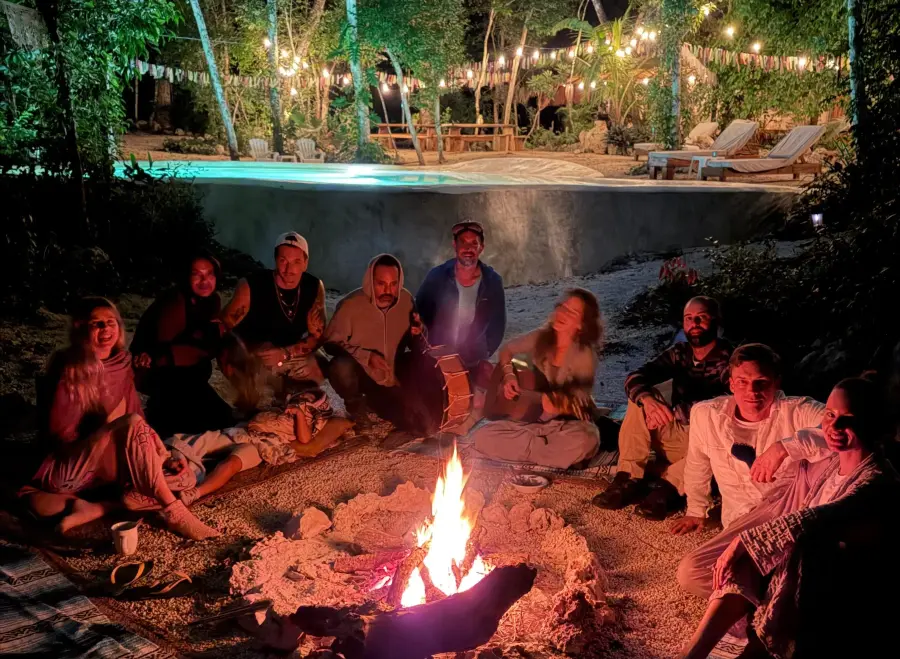
It begins the morning after the first ceremony, in circle — speaking what arose, hearing it land in your own voice, letting the group witness it. The days between ceremonies are built for it too: the land, the cenote-fed pool, the quiet, the food, the time to not rush.
And it does not end when you fly home. In the weeks that follow, our integration guide Nina — author of Heart Medicine — holds two group video circles, so you land back into ordinary life with people who were there and a steady hand to check in with. If you want to go deeper, Nina also offers private one-to-one integration sessions through her practice, Avatar Healing Arts, and you are welcome to reach out to her directly. Alongside the circles, a written series walks with you through the early weeks — grounded, unhurried, and shaped by real integration practice. And beyond all of it, you can reach us directly. Once you have sat with us, our door stays open to you.
When to Reach for More Support
Most integration is carried by gentle, ordinary life. But part of taking this seriously is knowing when to reach for more — for yourself, or for someone you sat beside.
- If you feel unsettled, confused, or low — reach out. Contact us, lean on your circle, use your integration materials. You are not meant to do this alone.
- If something feels clinically off — persistent hopelessness, an inability to function, feeling disconnected from reality, or thoughts of harming yourself — speak with a mental health professional promptly. This is not a failure of integration. It is exactly when good care matters.
- In a medical emergency — chest pain, seizure, fainting, severe dehydration, or any acute crisis — contact your local emergency services in your own country immediately.
Beyond us and Nina, two external supports are worth knowing about: your own doctor or therapist at home, who knows your history — and El Faro, the support service run by the non-profit ICEERS, which offers integration support with trained facilitators on a donation basis and turns no one away for lack of resources. We point every guest toward it, because good support should not depend on us being the ones to give it.
None of this is either-or. Your own therapist at home, ICEERS, Nina’s circles and one-to-one sessions, the people you sat beside — who understand it in a way few others can — and the written series we send: these are all hands to reach for. You do not integrate alone unless you choose to.
Reciprocity — Integration as Giving Back
There is one more thread, and it is the one that keeps integration honest. In the traditions we have been trained in, you do not only receive. You also give. In the temazcal we speak of it plainly: you offer your sweat, your discomfort, your prayer — and in the giving, you are able to receive. It is a natural law, not a transaction.
Integration works the same way. What you were given in ceremony asks something of you in return — not payment, but participation. Living with a little more care. Being more honest with the people around you. Treating the medicine, the tradition, and the people who carry it with respect rather than as something to consume. The most grounded people we meet after ceremony are not chasing the next peak. They are quietly becoming more responsible, more generous, more themselves. That is the whole point.
If you are considering plant medicine, or you have already sat and are finding the integration harder than you expected, that is exactly the kind of thing we are here to talk through. Simply reach out and we are happy to walk through it with you.
This article is for informational purposes only and does not constitute medical or psychological advice. If you are struggling after a ceremony, or you have a history of mental health difficulty, please reach out to a qualified professional in your country.
Frequently Asked Questions
What is ayahuasca integration?
Integration is the work of carrying what happened in ceremony into your ordinary life — gently, and over time. It is not analyzing your visions or deciding what they meant. It is noticing what helps you become more grounded, more honest, more connected, and slowly letting that reshape how you live. The ceremony is a beginning. Integration is where it becomes real.
How long does ayahuasca integration take?
There is no fixed timeline, but the first few weeks matter most — that is when the experience is still open and most workable. Many people feel the real shifts unfold over the following months. Integration is not a project you finish; it is a way of paying attention that you return to. Expect fluctuation. Clear days and foggy days are both normal.
Do I need an integration coach or therapist?
Not necessarily. For most people, gentle daily life — rest, journaling, honest conversation, and time in the body — carries the work. Support helps when strong emotions surface or old patterns get loud. If you have a history of trauma or mental health difficulty, working with a therapist you trust is wise. ICEERS runs a donation-based integration support service called El Faro that turns no one away, and we point every guest toward it.
What if I feel worse after ayahuasca?
A difficult stretch afterward is common and does not mean something went wrong — surfacing grief or old feeling is often part of the process. What matters is not doing it alone. Reach out to us, lean on your support, and slow down. If you notice signs that need real care — persistent hopelessness, inability to function, thoughts of harming yourself, or feeling disconnected from reality — treat that as a reason to speak with a professional promptly. That is not failure. That is taking yourself seriously.
Can I talk to someone if I'm struggling weeks later?
Yes. Once you have sat with us, our door stays open to you — reach out any time. Beyond us, El Faro (run by the non-profit ICEERS) offers integration support with trained facilitators on a donation basis, and turns no one away. And for anything clinical, your own doctor or a mental health professional in your country is the right first call.
Does Casa Arkaana offer integration support?
Yes. Integration is built into the retreat, not sold as an add-on. There are morning circles after each ceremony, and after you go home our integration guide, Nina, holds two group video circles in the weeks that follow, alongside a written series that walks with you through the first weeks. And you can always reach us directly.