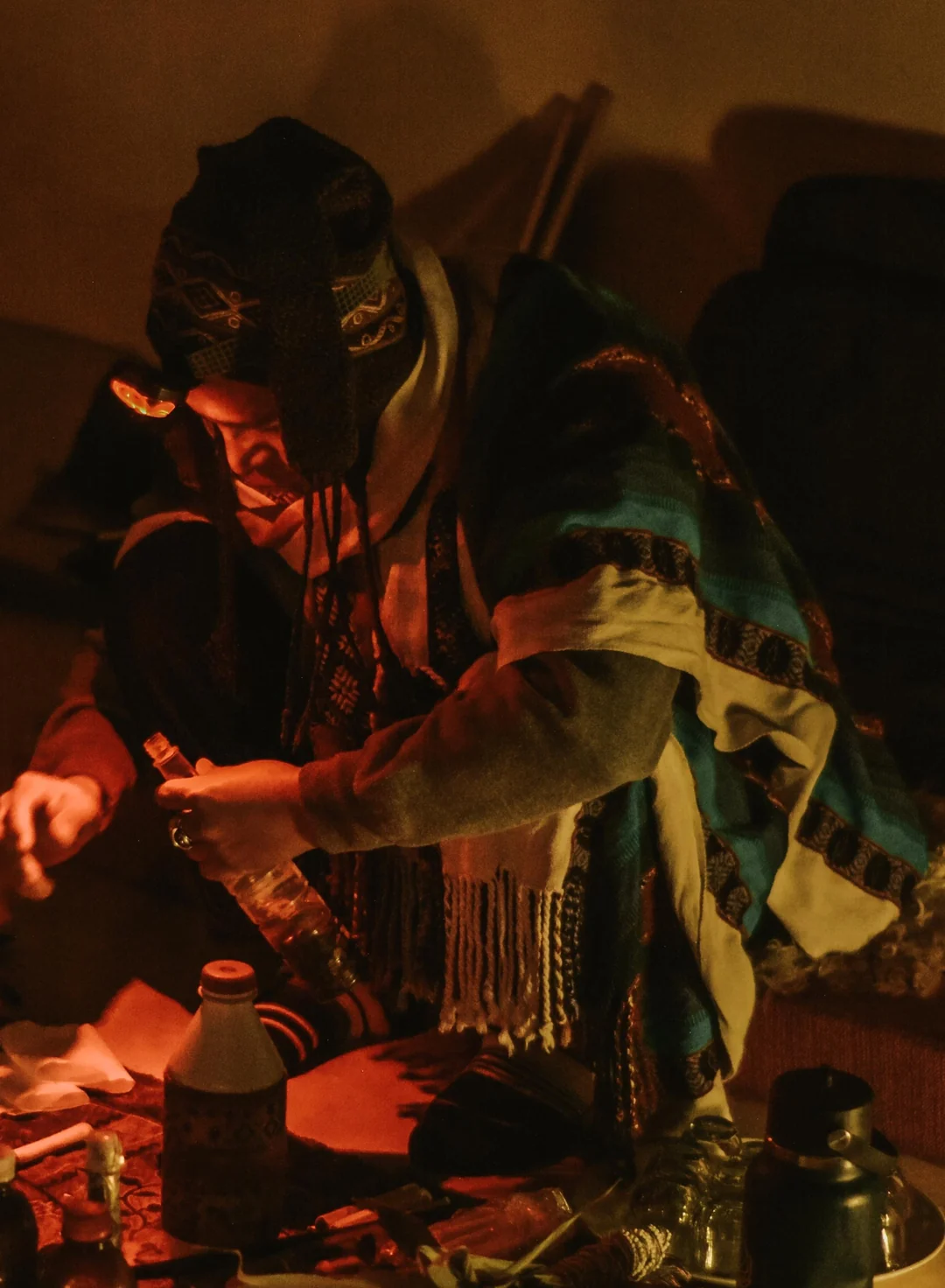
A master plant dieta is an ancestral Shipibo technology. One plant, taken in isolation, given room to teach. Where it comes from, what it asks, how the days run, and how it closes.
A master plant dieta is an ancestral Shipibo technology for healing and for learning from the plants. One plant, taken on its own, in isolation, and given enough quiet that its teaching becomes something you can feel.
Most people meet the word for the first time as a list of foods to avoid before a ceremony. That is not what it means.
Where dieta comes from
This is the part almost nobody explains, and it changes how the whole practice makes sense.
Traditionally the patient did not drink ayahuasca. Only the curandero did. He would drink to open his vision, and the person seeking healing would lie down in the centre of the space while he sang over them. The ayahuasca was how the curandero saw what was wrong. The healing came through the icaros, and through what he was shown.
And what he was shown told him which plants to prescribe. The master plant dietas were the treatment. The isolation, the plain food, the weeks alone with one plant: that was the medicine the patient was sent away with. Drinking ayahuasca yourself was not part of it, because that was the healer’s work, not yours.
The whole apparatus, dieting for months, drinking often, learning to sing, belonged to the curanderos. It was how you became one.
We do not know exactly when that changed. There is no record of a moment where it was decided, and we have never found anyone who can point to one. What is documented is that outsiders began arriving in the Amazon in numbers from the mid-1980s, that interest accelerated through the nineties, and that the first centres built for people coming from elsewhere opened around the middle of that decade. Somewhere in there the curanderos began giving the medicine to the people who came, and giving them dietas too.
Whether the plants told them to, or whether it was simply asked for often enough, we cannot say. We would like to know.
What we can say is that the practice had to bend to arrive here. People who fly in from cities are not built for the isolation a Shipibo apprentice takes for granted, and the shape of a dieta has become more flexible in response. That flexibility is not a dilution. It is what makes it possible at all for someone with a job and a family to sit with a master plant for two weeks.
The word does not mean diet
Search for ayahuasca dieta and you will mostly find food lists: what to eat and avoid in the fortnight before a ceremony. That matters, and we send it to every guest, but it is preparation. No sex, no alcohol, no fried food, no pork, in the run up to a ceremony.
The dieta is the practice itself. The restrictions inside it are one part, and not the part that does the work.
What the restrictions are for is subtraction. Salt, sugar, oil, spice, sex, physical contact, strong smells, company, screens, music, conversation. Each of these occupies attention. Remove enough of them and what is left is quiet, and in that quiet a plant that has been in your system for days becomes noticeable. The plant is not made stronger. Everything else is made smaller.
What it does
The plants work on the nervous system. They work on the emotional body, on grief and on what has not been let go of. Some work on the physical body. Machinga, the bone healer, is dieted for broken bones and for old structural injury held in the skeleton.
Underneath all of that, the tradition holds something simpler. We are energy, and energy behaves like a magnet. The plants align us, and an aligned person attracts different things into their life than a scattered one does. That is the part that is hardest to write down and the part people notice most in the months afterwards. It brings grace. It brings things into alignment.
Papa Gilberto’s way
Every Shipibo elder has their own way of doing this, and it matters which one you are sitting with.
Papa Gilberto is deeply traditional and, at the same time, unusually flexible. He is not strict with people, and part of the reason is that he can realign anyone. If you cross your dieta he has the power to put it right.
So nobody polices you. If you socialise, nobody will say anything. If you eat more than you need, nobody will say anything. If you walk to the internet café around the corner, nobody will say anything. But all of it lands somewhere.
The more you give, the more dieta gives back. The more you isolate, the cleaner you eat, if you fast for a day or two, if you stay off screens and away from reading, the more clearly you will feel your plant. That is the whole trade, and it is left in your hands.
He is also a man of few words. You cannot really go to him with questions. The answer he would give you is that the plants will show you, and mostly they do. What he does is hold the container in ceremony, and help you build a relationship between yourself and a plant that is genuinely powerful, inside a space that is safe.
What you actually give up
Food. At Papa Gilberto’s the food is rice, lentils, potato, sweet potato, plantain, oatmeal, boiled eggs, and occasionally chicken or fish. Tea is served. No salt, no oil, no spices.
People. This is looser than most people expect. At the table some talk and some do not. Some serve themselves and take their plate back to the tambo. Some sit and listen without joining in. Nothing is obligatory. There are workshops and integration circles on the days between ceremonies, and those are worth showing up for, but the choice is yours.
Contact. No sex, at all. It is better to have no physical contact with anyone. It is better not to share a bed with your partner. You can share a tambo, but ideally everyone has their own.
Sensory input. No perfume, no strong scents, no music. Ideally no phone, kept to the basics: a message home once in a while, an email if you need to.
The tambo, and the importance of getting bored
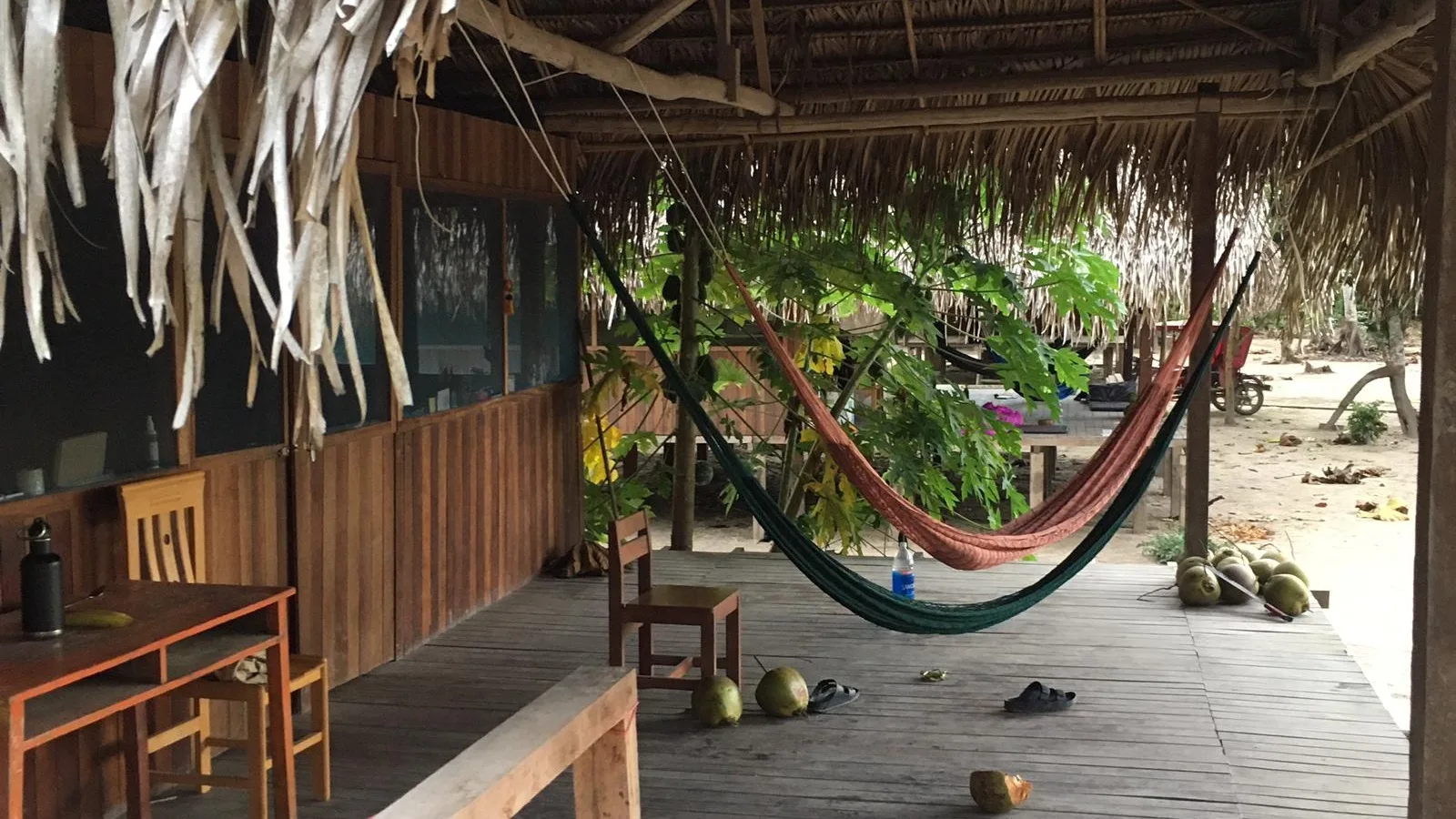
You have your own tambo. A bed, a hammock, a deck. It is where you go deep.
It is important to get bored. With children we say he is bored, put something on, and we have forgotten what boredom is for. Boredom is where creativity comes back, and where contemplation starts, and it is in those thin, uneventful hours that you can actually receive something from the plant. Not in ceremony. In the long empty afternoon afterwards.
You are not sitting in an empty box. You can bring an instrument, a drum, a guitar, a flute. You can draw, you can write. People go down to the river and make things out of what they find there, coconut, wood, stones. You can bring a book, though not a novel to pass the time. A book about plants, about life, something that feeds your dieta rather than distracting you out of it. We share a book of icaros and one on Shipibo cosmovision, so anyone who wants to can start learning the songs.
The aim is not to fill the time. It is to rest, and to let insight arrive. What is difficult is not the food. It is being left alone with yourself with nothing arriving to distract you, and it is also exactly where the work happens.
Which plant, and who decides
You do not usually choose your plant.
Papa Gilberto suggests it, in a one to one consultation on the day you arrive in the village, before the opening ceremony. Sometimes a person arrives with a strong feeling about a particular plant, and in that conversation he confirms it: yes, that is the one. Other times he says no, you need something else.
Either way, it is settled in that room, the day before you begin.
You can read what is held about the individual plants, and which of them are offered, on our master plant dieta page.
Where ayahuasca fits
The nights alternate, and the two medicines are doing two different jobs.
The first night is ayahuasca. Papa opens dieta with an icaro, the first arkana, calling in the spirits of the plants and of the jungle and setting a shield around the group. A protection bubble, almost a biosphere, sung into place before anything begins.
The second night is the palo. You drink your master plant at sunset. Then you go to your tambo. You do not talk to anyone and you do not meet anyone’s eyes. The plant works in your dreamscape through the night. The first thing the next morning is a cold shower, to close the crown, and after that you can look people in the face again. It is only asked for after a palo night, though it is a good way to wake up regardless.
Then it repeats, three times and no more. The palo is drunk on the second night, the fourth and the sixth, and that is all of it. Three brews, inside the first week.
After that the ceremonies carry on every other night to the end, and the nights between them are yours. Workshops, integration circles, rest. The plant is already in you by then, and the rest of dieta is it doing its work.
Ayahuasca is what lets you tap into what the master plant is already doing. Dieta is the foundation. The ceremonies are what is built on it. A dieta with no ceremonies is a coherent practice. Ceremonies with no dieta are a different and shallower thing.
The seed and the garden
Here is how the tradition understands what those few brews are doing.
Taking the plant is like planting a seed inside yourself. The spirit of the plant, its essence, put into the ground of your own body.
Imagine that body is a garden. Every dieta you sit plants another seed in it. And a seed on its own does nothing. It has to be cultivated: watered, fed, composted, given attention over time. In this tradition that cultivation is done by singing to the plant. That is how the relationship is built, and how it deepens, and how the plant becomes something you actually carry rather than something that happened to you once.
And it does not stop at the airport. It is good to sing to your palo when you go back, and to keep singing to it. That is what nourishes your dieta once the village is behind you.
That is the work. Not the seventeen days. The garden afterwards.
How a dieta closes
On the last ayahuasca night, Papa drinks with the group, and at some point in the night he gathers everyone and closes the dietas. Again with the arkana, the icaro of protection.
What that song is doing is telling the plants that the work is done. That it has landed and settled, and dieta is closed. From the next day, salt and lime and chocolate are allowed again. Normal food comes back.
But the cycle is thirty days, and it is not over when you leave. Whatever you did not spend dieting, you spend closing. Diet for ten days and the post-dieta is twenty. Ours runs thirteen days of dieting in the village, which leaves seventeen days once you are home.
For the rest of that thirty day cycle:
- No sex.
- No raw fish. No ceviche, no sushi. This is the one Papa says most often and the one people forget. It is the raw fish that matters, not the lime.
- No other plant medicines. No ayahuasca, no mushrooms, nothing of that kind.
And for sixty days, no pork. That one matters more than people think. Pork is not compatible with a dieta. Maja and Asdru have not eaten it in about eight years, simply because they are in ceremony often enough that it stopped being worth it.
The other half of the post-dieta is not a restriction at all. Sing to your palo when you are home. The seed is in the ground by then, and singing is how it gets watered.
People who treat the closing as a formality tend to be the ones who report that nothing lasted.
Who this is not for
People go to a dieta for one of two reasons. Either to heal something serious, or because they want to learn to hold the medicine for others.
Curiosity is not one of the two. If the thought is I would like to give it a try, this is not the thing to try. It is deep, it is long, and it asks a great deal.
You also need to arrive clean and strong enough to take it. If you have never sat with ayahuasca, sitting first is the sensible order. Most people begin with a retreat, in a group, with facilitators present through the night, and come to a dieta later if they come at all. That is the path we would suggest, and the reason our ayahuasca retreat in Mexico exists alongside the Master Plant Dieta.
It is worth coming with a group rather than alone, so that there is someone to help you understand what happened and carry it home.
It is also not for you, at least not now, if you are taking an antidepressant you cannot safely come off under a doctor’s supervision, if you have a personal or family history of psychosis or bipolar disorder, or if you are going through something acute enough that a fortnight alone would make it worse rather than better.
What to ask before you book one
Ask anything that genuinely comes up. But these are the ones that matter.
Will I be screened, and by whom? This is the most important question on the list. If nobody asks about your medication or your psychiatric history before taking your money, that is the answer to a different question you did not ask.
Who is the curandero, and what is their lineage? A name, a tradition, and a teacher. Vagueness here is the thing to notice.
How will the days actually run? Not a brochure sentence. What happens on a ceremony day, what happens on a plant day, what you are expected to do in between.
What happens before, and what happens after? Preparation, and then the post-dieta. If there is no answer to the second one, dieta is being sold as an experience rather than taught as a practice.
We run one dieta a year, each summer, in Paoyhan. Seventeen days, seven ayahuasca ceremonies, a plant chosen for you by Maestro Gilberto Mahua, and a village that has been doing this a great deal longer than any of us.
If that is where you are, the details are on the Master Plant Dieta page. If you are earlier than that, start with a retreat, and let dieta come when it comes.
Frequently Asked Questions
What is a master plant dieta?
A master plant dieta is an ancestral Shipibo technology for healing and for learning from the plants. One plant is taken on its own, in isolation, over a period of days, and the restrictions around it exist to quieten everything else so that the plant can be felt. In the Shipibo tradition this is how a relationship with a plant is built, and it is the ground the ceremonies stand on rather than an accessory to them.
Did patients always drink ayahuasca?
No. Traditionally the curandero was the only one who drank. He would take ayahuasca to open his vision, and the patient would lie in the centre of the space while he sang and worked. The healing was understood to come through the icaros and through what the curandero was shown, and the master plants were prescribed as part of the treatment. The model where the person seeking healing drinks the medicine themselves is recent, and it grew out of the arrival of outsiders in the Amazon from the mid-1980s onward.
How long does a master plant dieta last?
Dieta itself commonly runs from a few days to several weeks, and it is followed by a closing period. In this lineage the whole cycle is thirty days: whatever you do not spend dieting, you spend closing. Diet for ten days and the post-dieta is twenty. Traditional dietas undertaken by curanderos can run for months or years. Our own dieta in Paoyhan is seventeen days door to door, of which thirteen are dieting days in the village, leaving seventeen days of post-dieta once you are home.
What can you eat during a master plant dieta?
At Maestro Gilberto Mahua's centre the food is rice, lentils, potato, sweet potato, plantain, oatmeal, boiled eggs, and occasionally chicken or fish, with tea. No salt, no oil, no spices. The point is not nutritional purity. A strong flavour occupies the senses, and dieta is an exercise in removing what occupies the senses so that something quieter can be felt.
Do you drink ayahuasca during a master plant dieta?
Yes, and they are two different medicines doing two different jobs. The nights alternate at the start. Ayahuasca on the first night, the master plant on the second, ayahuasca on the third, the master plant on the fourth, and so on until the plant has been drunk three times inside the first week. After that the ceremonies continue every other night to the end of dieta and the plant is not taken again. The master plant is drunk at sunset and worked with alone in your tambo through the night. Ayahuasca is drunk in ceremony with the curandero singing, and in the tradition it reveals and amplifies what the dieted plant is already doing.
What is an arkana?
An arkana is an icaro of protection. It is sung to open a space and to guard what happens inside it. A dieta is opened with one, which invokes the spirits of the plants and of the jungle and sets a shield around the work, and it is closed with one, which tells the plants the work is done and settled. At Sama Nete Xobo, Papa Gilberto sings the arkana over dieta from the first night to the last.
What is the post-dieta?
The weeks after dieta closes, and they are part of the practice rather than the recovery from it. For the remainder of the thirty day cycle there is no sex, no raw fish of any kind, and no other plant medicines, including ayahuasca and mushrooms. Pork is avoided for sixty days, which is the one restriction people most often underestimate. Pork is not compatible with a dieta. Alongside the restrictions there is one thing you are asked to keep doing: sing to your plant. That is what goes on feeding your dieta once you are home.
How do you choose which master plant to diet?
You generally do not choose. Maestro Gilberto Mahua suggests the plant, in a one to one consultation on the day you arrive in the village, before the opening ceremony. Some people arrive with a strong feeling about a particular plant and he confirms it. Others he sends in a different direction. Either way the decision is made in that conversation, not before.
Can you do a master plant dieta at home?
Shortened forms are offered remotely by some teachers, and people do keep restrictions at home. What cannot be reproduced at home is the isolation, the plants themselves growing where they grow, and a curandero holding the container and adjusting. If you are considering it, treat a home dieta as a different practice rather than a smaller version of the same one.
Is a master plant dieta dangerous?
The risks are genuine and mostly manageable. They concentrate in three places: medications that are contraindicated with ayahuasca, existing psychiatric conditions, and the isolation itself, which is difficult for some people in ways they did not anticipate. Any centre worth going to will screen you before accepting you. If nobody asks you about your medication or your mental health history, that absence is the answer.