Janzu is aquatic therapy — floating bodywork that frees the body and quiets the mind. What it is, how it differs from Watsu, and where to receive it near Tulum.
There is a moment, once the water has taken your weight, when the mind stops. The body forgets where it ends. You are moved, and you did not decide the movement, and for once that is a relief.
That is where Janzu begins. Not with a technique, but with letting go.
What Is Janzu?
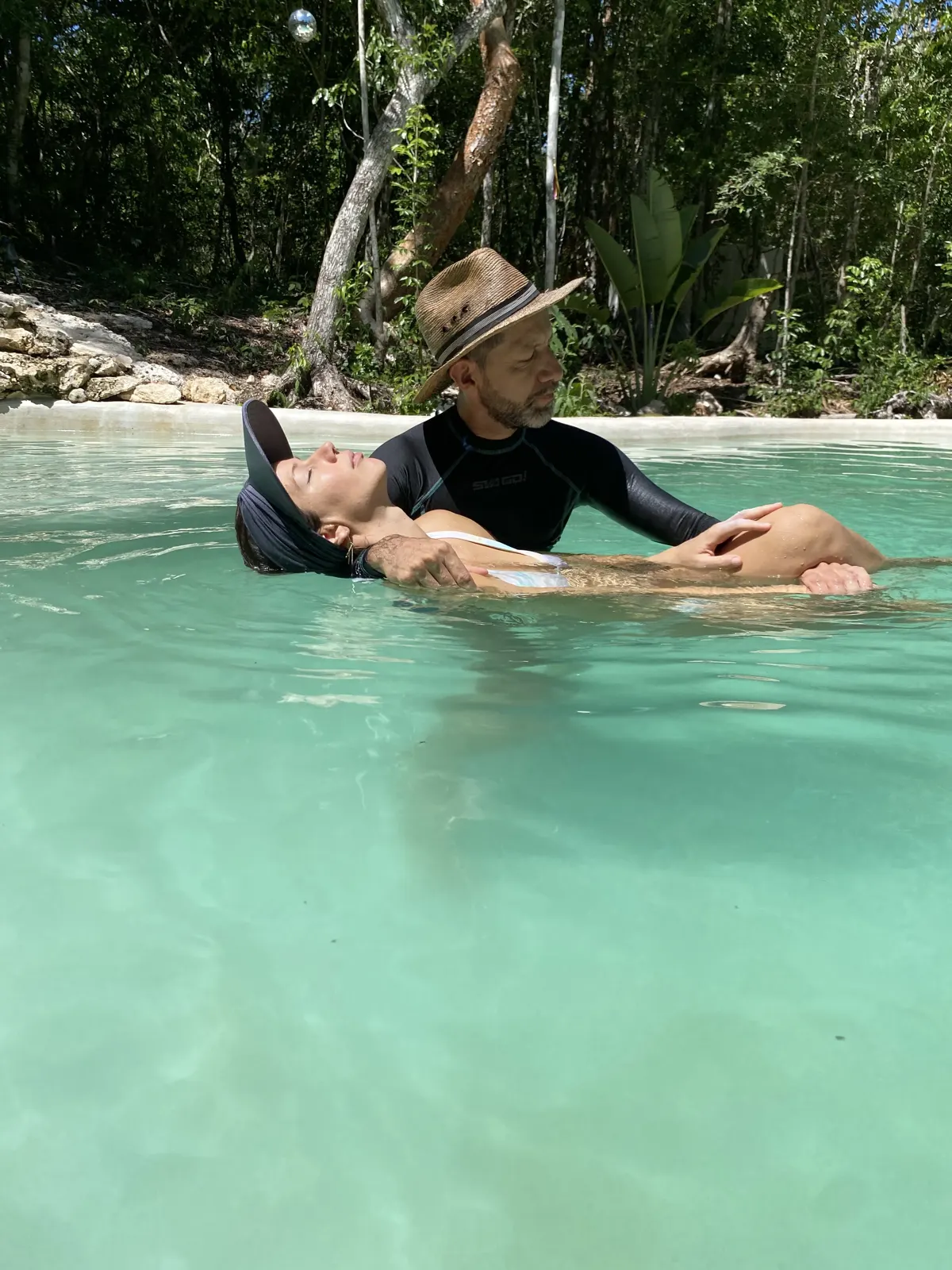
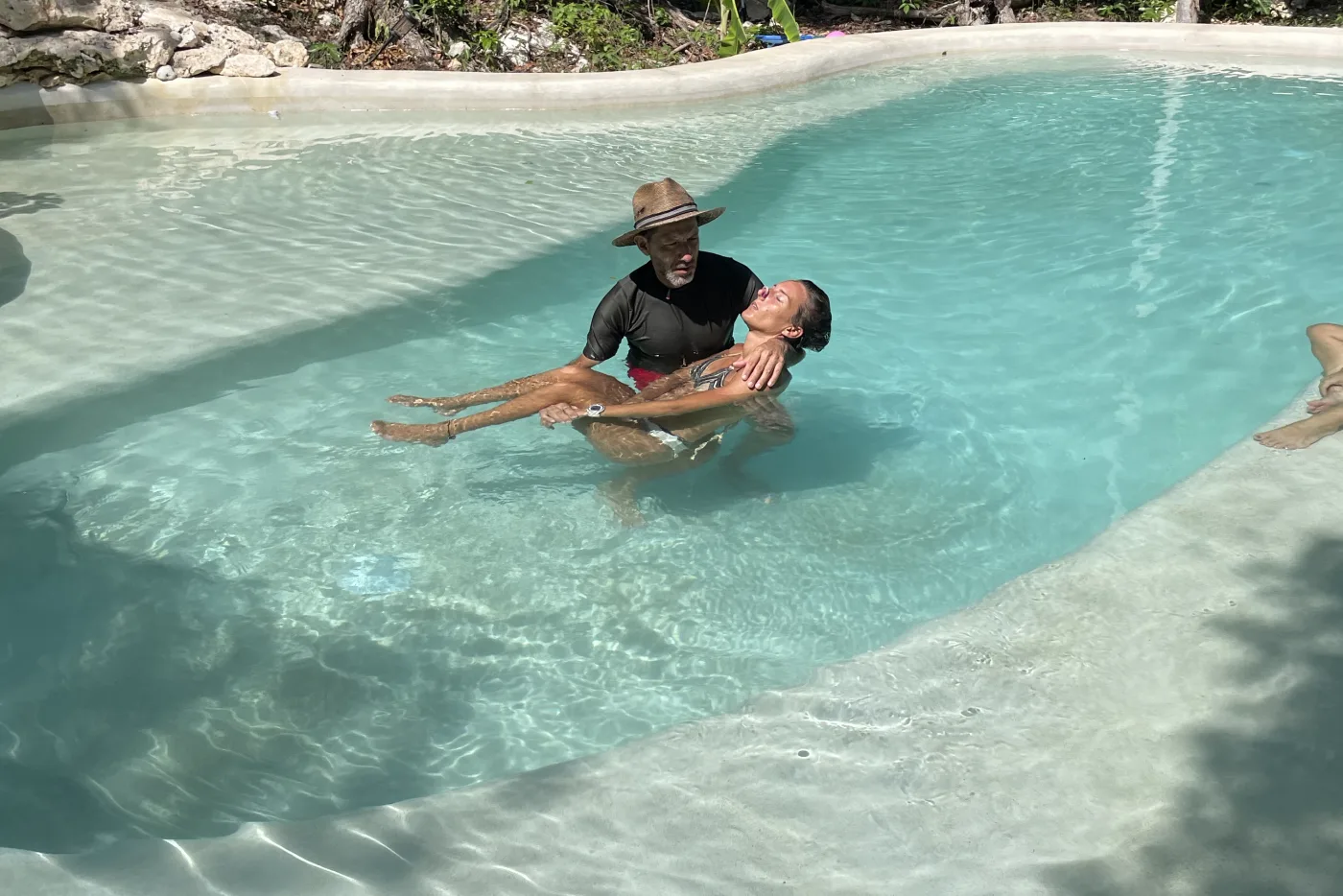
Janzu is a form of aquatic therapy — bodywork received while you float, supported the whole time, in warm or cool water. I guide the movement; you do nothing but breathe. Slow rocking, long stretches, gentle rotations, moments beneath the surface. The water carries what your body usually carries alone.
The practice was created by Juan Villatoro. As it was passed to me, he had spent time in an ashram in India, learning many disciplines — tai chi, chi kung, the long stretches that feel close to Thai massage, the pressure points of shiatsu. He took all of these ancestral practices and brought them into the water. So the lineage of Janzu is really the lineage of those older traditions, joined together and given to the element of water.
The style I practice came down through Lago de Atitlán, where the work was shared for a long time, and where my teacher, Sol Naciente, learned it. That is part of why we often work in cooler, fresher water rather than a heated pool. I completed the three levels with him, and I have been giving this therapy for the last 15 years.
The Difference Between Janzu and Watsu
People often search for Watsu and find Janzu, I would like to bring clarity about how they differ, because they are close cousins.
Watsu is usually given in a pool kept warm — around 35°C — with movements that are soft and paused, following a specific method. It is, you could say, a little more studied, a little more structured. There is a clear sequence.
Janzu can be given in warm water too, but it is more often practiced in cooler water, and it moves differently. It follows the breath more closely, and it improvises. There is a sequence we learn, so that the work stays coherent — but from there, each person receives a different session. Every body is different. The day is different. If there is wind, if the water is moving, all of that becomes part of the session. It is an improvisation in the present moment.
And this is the heart of it, the way my teacher describes it: Janzu is a practice of letting go of control. Both the one giving and the one receiving release the mental patterns we hold, the need to manage and direct. If I am thinking, I will control this with the sequence I was taught, I have already left the water. The practice asks me to stay open and let the moment lead — the body in front of me, the breath, the day. When I can meet another person’s breath and move with it, the session reaches much deeper — in the body, the mind, and the emotions.
Janzu belongs to a wider family of aquatic therapies. Watsu, Aguahara, WaterDance — different names, different lineages, but the same root understanding: that being held and moved in water lets the body release what it cannot release on land. Janzu is the practice we carry here. If you have already received one of the others, you will recognize the feeling. If this is your first time meeting water this way, you are in good hands.
What a Session Feels Like
First there is lightness — in the muscles, the bones, the ligaments and tendons. Floating releases the parts of the body that were holding tension, and you feel it let go.
Then time and space begin to slip. Your eyes are closed and you are being moved in different directions, and you lose track of where you are. You might feel yourself in one corner of the water, and when the session ends and you open your eyes, you are somewhere else entirely.
If you can meet your own breath — or if I can meet it for you and time the movement to it — then even the immersions under the water feel natural. There is no urgency to breathe. It feels so easy to be down there that the mind never sounds the alarm.
And at the end, there is the quiet. Our minds talk to us all the time — what am I going to do, how will I do it, what next — bombarding us. After a session of Janzu, that voice can go completely silent. What is left is presence. You feel every sensation in the body, every breath, every color, and it is all vivid and strong, because the mind is finally still and you are fully here. That clarity is what people carry out of the water.
The Benefits — Body, Mind, and Emotion
Janzu is an integral therapy — it touches every level at once.
In the body, the water lifts the weight we normally carry, and the muscles, joints, and tendons release. It is a physical lightness that is hard to reach on land.
In the mind, the constant talking quiets and clarity comes. People leave a session more settled than they have felt in a long time.
In the emotions, water is the element of feeling. By flowing with it, we also release the emotional burdens that sit in the physical body. Things loosen in the water that stay locked on dry ground.
Water as Teacher
I will tell you something I do not share often.
When I was a baby, my father took me to a beach in Zihuatanejo where the waves are strong and high. He carried me on his shoulders into the water, and a giant wave took me from him. For a while I was lost in the sea — no one could see me — until, after some minutes, the same wave carried me back and they found me.
I do not remember it. My mother tells the story. But she says that from then on, all through my childhood, water was a difficult thing for me. Even being bathed was hard. By the time I was eight or nine, I did not want to get into the sea or a pool. I could not.
When I came to Tulum, that had to change. I wanted to explore the water, the reefs, all of it — so I had to find the courage to get in. And Janzu is a large part of what freed me. Through this therapy I released that old fear completely. Since then I have worked with many people who arrived carrying a fear of water, and again and again, the water — held the right way — becomes the very thing that heals it.
That is what this practice has given me: not just a technique to share, but a way to bring what was stuck to the surface, release it, and move forward. It is why I teach it.
Aquatic Therapy in the Riviera Maya
The Riviera Maya is water country. It sits on top of cenotes — the underground rivers the Maya have held sacred for thousands of years. It is a rare place to receive aquatic therapy, because the water itself is alive.
At Casa Arkaana, in Chemuyil, 20 minutes north of Tulum, Janzu is given in a pool fed by that cenote water — cool, mineral-rich, and quiet. No ocean noise, no crowd. Just the water, five acres of old-growth Mayan jungle around it, and the session. The pool was designed intentionally for aquatic therapies and is one of a kind in the region.
Learn Janzu at Casa Arkaana
You can receive Janzu here as a session, or you can learn to give it. I teach the fundamentals over one day at a time — Level I for the foundations, Level II to go deeper — in the cenote-fed pool. Bodyworkers, therapists, yoga teachers, and complete beginners all come. And once people feel the water, they want more of it: this past season, someone flew in from Florida just to take the second level.
If you want to receive a session, learn the practice, or simply ask whether Janzu is right for you, reach out directly or see the weekend trainings, or, if you want to learn it well enough to offer it, the certification week in May. The water is the best teacher; a page can only point toward it.
Frequently Asked Questions
What is Janzu?
Janzu is a form of aquatic therapy — floating bodywork received in warm-to-cool water. The receiver floats, supported the whole time, while the giver moves, stretches, and rocks the body in slow, continuous motion, coordinated with the breath. It was created by Juan Villatoro as a blend of movement and bodywork traditions — tai chi, chi kung, long Thai-style stretches, and the pressure points of shiatsu — all brought into the water. The water carries the weight the body normally holds, and something in the nervous system lets go.
Is Janzu the same as Watsu?
They are close cousins, but not the same. Watsu is usually received in a warm pool held at around 35°C, with softer, slower movements and a specific, studied method. Janzu can be given in warm water too, but it is often practiced in cooler, fresher water, it follows the breath more closely, and it improvises more — the session shapes itself around the person, the day, even the movement of the water. Both let go of control. Janzu simply asks the giver to stay in the present moment rather than follow a fixed sequence.
Is Janzu a kind of aquatic therapy like Watsu or Aguahara?
Yes. Janzu belongs to the same family of aquatic therapies as Watsu, Aguahara, and WaterDance — all of them work with being held and moved in water to release the body and quiet the mind. Janzu is the practice we offer at Casa Arkaana, given in our cenote-fed pool. If you have received one of the others you will feel at home, and if it is your first time, no experience is needed.
Do I need to know how to swim to receive Janzu?
No. You are supported the entire session — your head is held above the water and you never have to hold yourself up. Many people who cannot swim, and even people who are afraid of water, receive Janzu safely and find it deeply freeing. You do nothing but float and breathe.
Is Janzu safe if I'm afraid of water?
Yes — and it is often exactly the practice that helps with that fear. You are held the whole time, nothing is forced, and the pace follows your breath. I carried a fear of water for most of my life, and Janzu is a large part of how I released it. I have worked with many people who came in afraid of the water and left feeling safe in it.
What are the benefits of Janzu?
Janzu works on the body, the mind, and the emotions at once. In the body, floating releases the weight held in muscles, joints, and tendons — a deep physical lightness. In the mind, you lose the sense of time and space and the constant inner talking goes quiet, leaving real clarity. Emotionally, water is the element of feeling — moving with it helps release emotional burdens the body has been carrying. Many people come out calmer, clearer, and lighter than they have felt in a long time.
Where can I experience Janzu near Tulum?
Casa Arkaana is in Chemuyil, about 20 minutes north of Tulum, on five acres of Mayan jungle. Janzu here is given in a pool fed by cenote water — cool, mineral-rich, and quiet, with no ocean noise and no strangers. Sessions and trainings are held by appointment. It is one of the few places in the Riviera Maya dedicated to aquatic therapy in water like this.
What should I wear for a Janzu session?
A comfortable swimsuit is all you need. We provide floats for the ankles so your legs rest easily, and you keep your ears near or under the water for most of the session — many people wear ear plugs. Bring a towel and something warm for afterward, because you come out of the water very relaxed and open.
Do I need experience to take the Janzu training?
No experience is required for Level I — it teaches the fundamentals from the beginning: the principles, how to open and close a session, how to guide the receiver's movement, and breath as the bridge. Level II deepens the practice and asks that you have completed Level I first. Bodyworkers, therapists, yoga teachers, and curious beginners are all welcome.