Mexico is not where ayahuasca comes from — but it may be where it meets you. A practical guide to lineage, legality, safety, and choosing the right retreat.
Mexico Is a Bridge. That Is Exactly What It Is.
Ayahuasca has roots. Real ones. The Shipibo-Conibo of the Peruvian Amazon. The Yawanawá and Huni Kuĩ of Brazil. The Yageceros — the Taitas — from the Putumayo region of Colombia. The Santo Daime tradition, also from Brazil. The curanderos of Ecuador. This medicine, in its many forms and traditions, comes from the south.
We are not from the south. We are not claiming to be.
What Mexico is — and what this region specifically is — is a bridge. A legitimate, living meeting place between those traditions and the people who are beginning to find their way toward them. Most of those people are not ready to spend three months in the Peruvian jungle working with a master curandero in deep isolation. Many of them will be, eventually. But they are not there yet. And that is not a failure. It is a beginning.
Casa Arkaana exists inside that beginning. We hold a container — grounded in respect for where this medicine comes from, connected to the living lineages that carry it — for people who are ready to do real work, in a place that will hold them well.
This Land Has Its Own Medicine
It would be wrong to say that Mexico has no relationship with sacred plant medicine. The opposite is true.
The Wixárika — known in Spanish as the Huichol, a name given during the colonial period — are the keepers of the peyote tradition, one of the oldest and most intact ceremonial practices in North America. The Mazatec people of Oaxaca have worked with psilocybin mushrooms since long before those mushrooms had a Latin name or entered the global conversation. Across Mexico, there is a deep tradition of herbolaria — healing with plants, carried by curanderas and healers in every region. Energetic medicine, bone setting, prayer, ritual — these are not new here. They live in the hands and the blood of Mexican culture.
Ayahuasca, specifically, is not from Mexico. But it has been received here with seriousness, and it is held here by people who understand the responsibility that comes with it. Asdru and Maja have been sitting with their Shipibo Maestro for eleven years. They are not facilitators. They are witnesses, students, and co-holders — people who understand what a container must be before it can hold anyone else.
The Meeting of the Eagle and the Condor
There is a teaching that has traveled across the Americas for generations — carried by runners, by ceremony, by the people who still remember it. It speaks of the Eagle of the North and the Condor of the South. Two paths that were once separated. The path of the mind and the path of the heart. The path of industry and the path of the earth. The prophecy says that one day they would fly together again.
They meet in the middle. They have always met here.
In 1992, the first Peace and Dignity Journey — a ceremonial run connecting the continent — departed simultaneously from Alaska and Tierra del Fuego. The runners met at Teotihuacan, just outside Mexico City. That was not a coincidence. Mesoamerica has always been the crossroads.
What that means for plant medicine is visible if you pay attention. Shipibo healers come north to Mexico. Taitas from the Putumayo travel through. Yawanawá and Huni Kuĩ teachers make their way up the continent. The traditions move — not because Mexico is the destination, but because it is the meeting place. Information passes through here. Lineages encounter each other here. Something is gathered here that is hard to name and easy to feel.
What You Find Here That You Will Not Find Elsewhere
Nature with infrastructure.
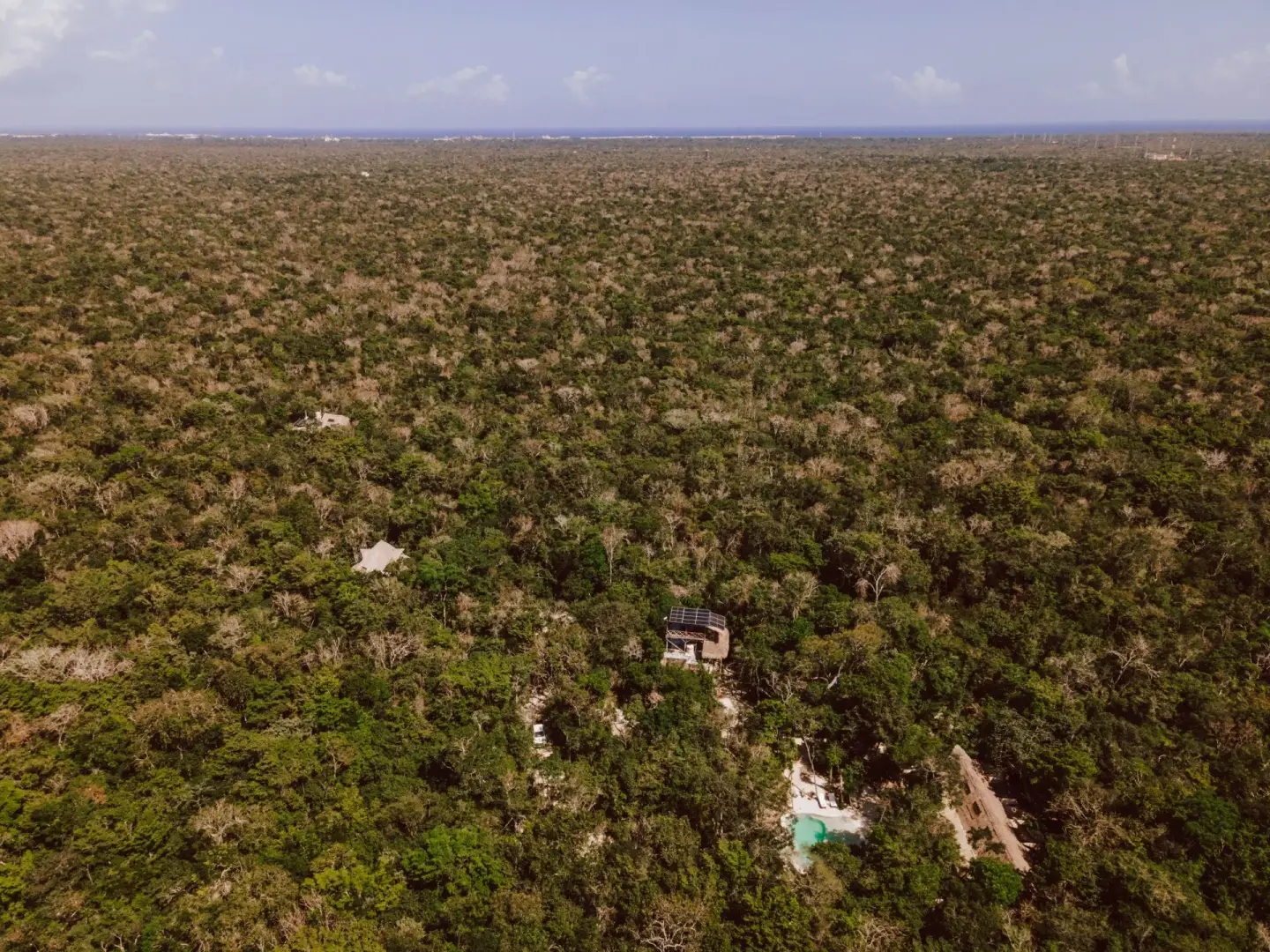
Casa Arkaana sits on a biological corridor — a living stretch of Mayan jungle where jaguar still move at night, where spider monkeys pass through the canopy, where boas and toucans and deer share the same land. The underground river system beneath us has been flowing through limestone for millennia, and the cenotes it surfaces through have been sacred to the Maya — connected to Xibalba, their cosmovision of the underworld — since before any of our lineages were named.
And yet: there is reliable internet. There are medical facilities within reach. There is airport infrastructure — Cancún is one of the most connected airports in the Americas, with direct flights from New York, London, Toronto, Berlin. The temazcal on this land is built and held in the Mesoamerican tradition. The kitchen feeds the group with food that honors the work being done.
Peru will give you depth of immersion that is impossible to replicate. If you are ready to spend a month in isolation, to diet with a master curandero, to be fully removed from everything familiar — Peru is where that happens. We will tell you that honestly, and we will tell you it is worth doing if you are ready.
But most people are not ready for that first. And for the people who are beginning — or who need to remain partially connected, or who cannot disappear from their lives for a month — the ability to do serious plant medicine work in a container that holds both the jungle and the infrastructure is not a compromise. It is what makes this work accessible.
The Caribbean, ten minutes away.
After a retreat — after days of ceremony and integration and the slow work of finding your ground again — there is the Caribbean. That is hard to explain and harder to overstate. If you need it, it is there.
What You Will Not Find Here
We will not pretend to be what we are not.
If you want to sit with a Shipibo maestro in their own community, in the Amazon, in the original context of the tradition — that is Peru, or Brazil, or Ecuador. What comes to Mexico is always a form of meeting: a tradition held in new geography, by people who have carried something across a distance. The question is always whether what has been carried is genuine, and whether the space that holds it is worthy.
For the deepest immersion — long dieta, total isolation, chronic illness, profound transformation over months — you go to the source. That is not us. We are the tip of something larger. We serve the beginning of the path, and we do it seriously.
The Legal Reality in Mexico
Mexico does not list ayahuasca as a controlled substance under its General Health Law. The brew itself is not scheduled.
DMT — one of the active compounds — is controlled as an isolated substance under Mexican law. Courts have in some cases interpreted this as extending to the brew, particularly in cases involving transport across state lines or borders. In 2022, several Indigenous practitioners were briefly arrested at Mexico City airport while traveling with ayahuasca. All were released.
What the enforcement pattern shows: ceremonies held at retreat centers in Mexico have not resulted in legal action against participants or facilitators. The risk is in transport, not in ceremony. Practitioners operating within a recognized Indigenous ceremonial lineage have the strongest legal standing, supported by Mexico’s constitutional protections for Indigenous cultural practices (Article 2) and a 2021 Supreme Court ruling affirming the right to personal autonomy in consumption.
The legal landscape continues to evolve. We follow it carefully.
This is for informational purposes only and does not constitute legal advice.
The Six Questions That Actually Matter When Choosing a Retreat
Lists of “best ayahuasca retreats in Mexico” are everywhere. Most are advertising. Here is what to actually ask.
1. What is the facilitator’s lineage and training?
Where did this person learn? From whom? For how long? A genuine lineage holder can tell you the name of their teacher and the tradition they trained in.
2. What does the screening process look like?
A ceremony holder who does not screen participants does not take responsibility for what they are holding. Health history, medications, contraindications — these are not bureaucracy. They are care.
3. What is the group size, and who holds it?
Eight people with one experienced facilitator is a fundamentally different experience from thirty people with a team of varying backgrounds.
4. What happens before and after the ceremony nights?
Preparation and integration are what determine whether what opens in ceremony becomes something lasting. Ask specifically.
5. What is the space, and what has happened there?
A purpose-built ceremonial temple on land that has been tended with ceremony is different from a rented villa. The energetic history of a space is real.
6. What does integration support look like after you leave?
Integration is where the real work happens. What is in place when you return home?
For Seekers: Practical Logistics
Travelers from the US, Canada, EU, and UK do not need a visa for Mexico for stays under 180 days. Make sure your passport has at least two months of validity remaining — airlines and immigration can deny boarding if a passport is close to expiration. Fly into Cancún (CUN), roughly 90 minutes by car to the Tulum area, with direct connections from most major North American and European cities.
Best time of year: October through May offers the most comfortable conditions. Casa Arkaana hosts retreats from September through June and uses July and August for maintenance and restoration.
How long to plan: Most plant medicine retreats run five to seven days. Build in at least a day on either end — one for arrival and settling into the land before ceremony begins, one for rest before you travel home. If you can take a full week after the retreat before returning to your normal life, that is ideal.
For Facilitators: What Hosting in Mexico Looks Like
Mexico sits at a unique intersection: serious ceremonial work in a place that is genuinely easy to reach. Participants fly in without visas, on direct flights from most major cities in North America and Europe. The journey to get here does not have to be the hardest part.
At Casa Arkaana, Asdru and Maja are present throughout every retreat — not as property managers, but as co-holders of the container. If you are a facilitator looking for a venue that understands this work from the inside, the host page for plant medicine retreats explains what that collaboration looks like.
Frequently Asked Questions
Is Mexico a good alternative to Peru for an ayahuasca retreat?
They are genuinely different experiences — not better or worse than each other. Peru offers deeper immersion in original Amazonian ceremonial traditions in their home context. Mexico offers accessibility, infrastructure, the unique environment of Mayan jungle and cenotes, and a living meeting place for traditions traveling from the south. For people beginning this path, or for those who cannot fully remove themselves from the world for weeks at a time, Mexico — and this region specifically — serves a real and important purpose.
How do I verify a facilitator’s lineage?
Ask directly: who did you train with, and for how long? A practitioner who carries a real lineage can name their teacher and the tradition they trained in. Uncertainty or vagueness in that answer is information.
Are plant medicine retreats safe in Mexico?
Safety depends on the facilitator and the container, not the country. Does the facilitator screen participants? Are contraindication protocols enforced? Is there medical support available if needed? Those are the questions that determine safety.
What time of year is best for a retreat in Mexico?
October through May. High season runs late September through June — drier, more comfortable, and the period when most retreats are scheduled.
How long should I plan to stay?
Most retreats run five to seven days. Build in at least a day on either end — and if you can, take a full week after the retreat before returning to your normal life.
This article is for informational purposes only and does not constitute legal or medical advice.